The Potato Taste Defect — What’s Really Happening in Your Cup?
Every Q Grader who has worked with Great Lakes coffees knows the moment: a Rwanda or Burundi that should sing with stone fruit, and instead — raw potato.
Here’s the science behind it.
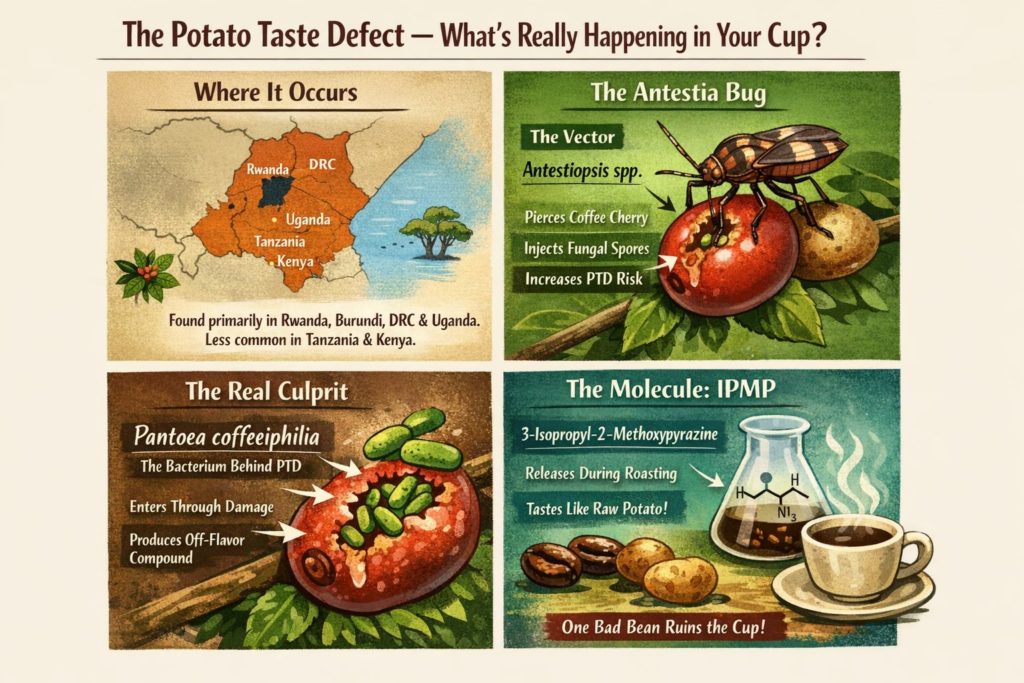
– Where it occurs PTD is found primarily in Rwanda, Burundi, DRC, and Uganda, and less frequently in Tanzania and Kenya. First documented in the eastern DRC, its biochemistry is still being actively investigated.
– The vector: Antestiopsis spp. The Antestia bug (Hemiptera: Pentatomidae) pierces the cherry and injects toxic saliva and fungal spores directly into the fruit. Just one additional bug per tree raises PTD risk by 73%.
– The real culprit: Pantoea coffeiphilia The Antestia is a vector, not the cause. The wounds it creates allow Pantoea coffeiphilia — the bacterium responsible for PTD — to enter the cherry. Crucially, mechanical damage alone, without any insect, is sufficient to trigger the same pathway.
– The molecules: IPMP & IBMP According to the 2023 World Coffee Research white paper, PTD involves not one but two odor-active compounds: 2-isopropyl-3-methoxypyrazine (IPMP) and 2-isobutyl-3-methoxypyrazine (IBMP) — both produced by bacteria colonising the surface of damaged beans, and only volatilised during roasting. This is why PTD is invisible until the grind.
In the cup: raw potato, damp earth, starchy mustiness. And a single affected bean can ruin an entire brew.
– The economic reality The impact goes well beyond the sensory. According to WCR, PTD can reduce the price of a quality coffee by up to 57%. Worse, international buyers often penalise entire origins — pricing down lots with no specific evidence of PTD in the batch. That’s a structural injustice for producers who depend on coffee as their primary income.
How to prevent it
At farm level (WCR, 2023): — Complete removal of all fruit at end of harvest to eliminate pest food sources — Regular pruning — Antestia prefer dense, shaded canopy; open trees create unfavourable conditions — Targeted application of pyrethrum (natural insecticide) combined with smart IPM timing: right dose, right moment
At wet mill level: — Cherry flotation to remove less-dense, insect-damaged fruit — Post-fermentation visual sorting for colour defects and “zebra beans” (brown-streaked parchment) — UV light scanning and laser sorting, already deployed in Rwanda, to detect damaged beans — Anecdotal evidence suggests commercial yeasts during fermentation may help outcompete PTD bacteria
At roaster/barista level: — Cup more samples per lot to screen adequately — Grind smaller test batches (30g rather than 100g) — if PTD appears, purge the grinder and discard; one bad cup doesn’t condemn the bag — Educate your team: PTD is sporadic, not systemic
PTD is not a reason to avoid Rwanda, Burundi, or DRC. It’s a reason to know them — and their producers — deeply.