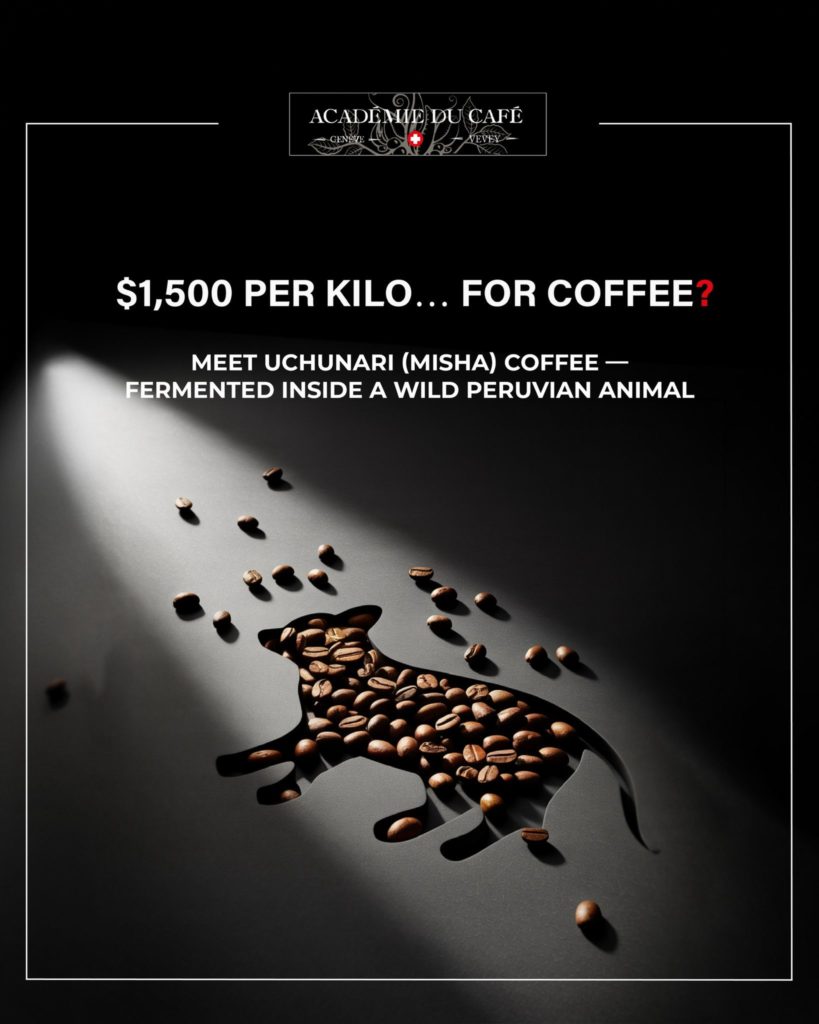
Did you know that ?
Uchunari or Misha Coffee : the Coffee That Passes Through a Peruvian Wild Animal — And Costs Up to $1,500/kg
Animal-processed coffees occupy a peculiar space in specialty: simultaneously cited as exceptional and dismissed as novelty. Misha Coffee from Peru warrants a more rigorous look — both at the biochemistry and at the supply chain conditions that determine whether it belongs on a specialty menu at all.
Origin and botanical context Misha Coffee is produced in Chanchamayo and Satipo, department of Junín, at 1,300–2,000 m.a.s.l. — the Andean-Amazonian transition zone known as the selva alta. Arabica varieties cultivated here — principally Bourbon, Caturra, and Typica.
The mechanism: enzymatic fermentation in vivo The vector is the South American coati (Nasua nasua, Procyonidae), known regionally as uchunari or mishasho. As an obligate frugivore, the coati selects ripe cherries based on sugar content and aromatics — not trained discernment, but evolutionary optimisation toward peak Brix fruit. The sensory outcome is consistent across reported cuppings: markedly reduced bitterness, attenuated acidity, full and velvety body, with descriptors including dark chocolate, Amazonian fruit, soft terroir notes, and mild spice. At $1,400–1,500/kg, it ranks among the world’s most expensive commercial coffees — a function of extreme production scarcity (~450 kg/year from organised Junín collectives) and the labour intensity of wild or semi-wild collection.
The quality and ethics are inseparable Here is where the specialty industry must be more disciplined than the luxury market. The flavour profile of Misha Coffee is real. The biochemical transformation is documented. But the same demand that elevated Kopi Luwak to global prominence also produced one of the most widely documented animal welfare scandals in the food industry — civets confined in wire cages, force-fed cherries, denied behavioural expression. The parallel risk for coatis is not hypothetical. A cup that scores well on the sensory form but fails on traceability and welfare verification is not a specialty product. It is an ethical liability with a good flavour note. Before sourcing, recommending, or featuring Misha Coffee, the questions that apply to any credible specialty lot must apply here with greater rigour: What are the documented holding conditions? Is third-party welfare certification in place? Is the claimed wild or semi-captive sourcing independently verifiable?