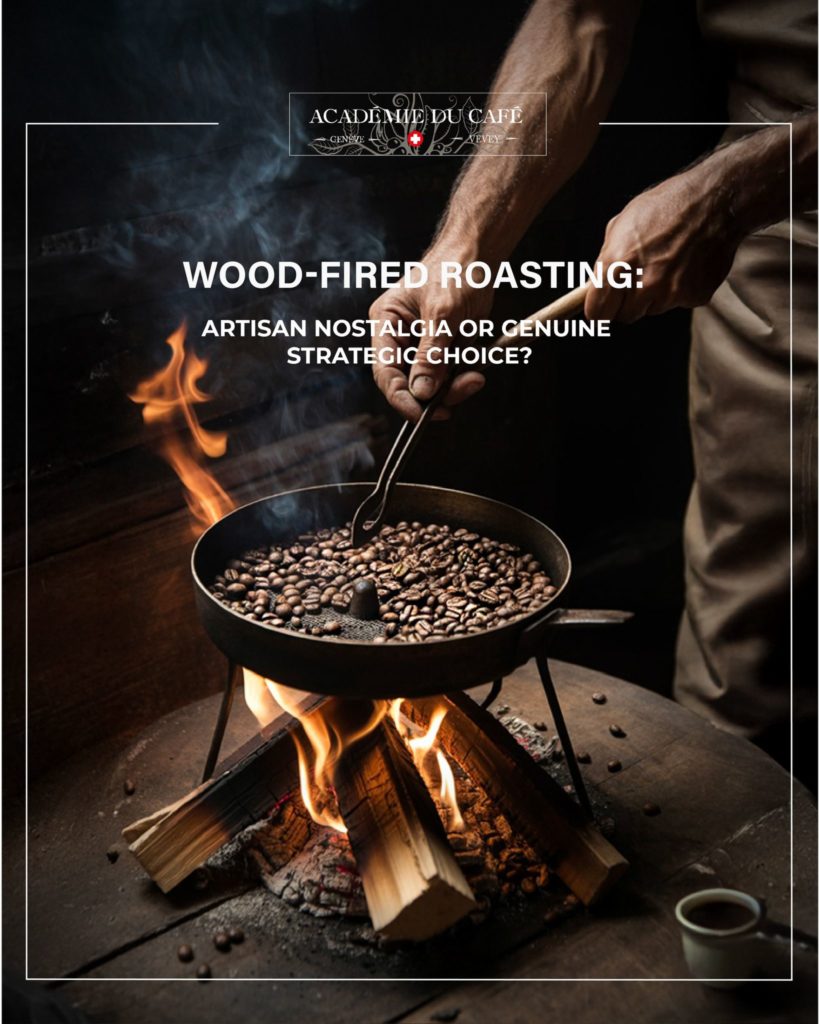
Wood-fired roasting: artisan nostalgia or genuine strategic choice?
In a sector dominated by natural gas — and under growing pressure from electric roasting — wood firing is making a quiet but significant comeback. Here’s what I’ve learned combining technical data and field experience.
Why wood never truly disappeared
Gas replaced wood for obvious reasons: precise control, easy logistics. And yet, houses like Mr. Espresso in Oakland — founded in 1978 — never abandoned it. The reason? Natural gas is a dry fuel. Wood naturally contains ~15% moisture. It’s that moisture that generates a softer, more enveloping heat — structurally different from anything gas produces.
What wood actually does inside the drum
Contrary to popular belief, wood roasting does NOT smoke the coffee. The flame never contacts the beans directly. It’s the hot air from combustion that circulates around the rotating drum.
What wood actually brings is a modified thermal profile: → Slowed Maillard reaction (260–280°C vs 420–440°C with gas) → Roasting time 3 to 4× longer → More body, lower acidity, more developed crema → Zero woody flavour transfer — combustion is complete
Wood vs Gas vs Electric
Wood excels for traditional Italian-style profiles — rich body, roundness, sweetness. Gas remains king for instant reactivity, ideal for specialty filter. Electric delivers perfect repeatability for industrial consistency.
Wood’s real limitation: logistics. Storage, drying (moisture must stay below 20%), regular supply — structurally incompatible with large-scale production.
IMF: the technological synthesis
IMF had the intelligence not to choose between tradition and technology. Their wood roasters use the same architecture as their gas models: combustion generates air at ~600°C, which the Vortex system blends with cold ambient air to reach precisely the required roasting temperature. Integrated afterburner for emission treatment.
The result: the soft, moist heat of wood + the precision of a fully modern machine.
How much wood for a 60 kg batch?
Estimate: 10 to 12 kg of dry oak per 60 kg batch — roughly 0.17 to 0.20 kg of wood per kg of roasted coffee.
My conclusion
Wood roasting is not nostalgia. It’s a technical choice that produces a structurally different coffee — and makes genuine environmental sense when wood is locally sourced from sustainably managed forests.