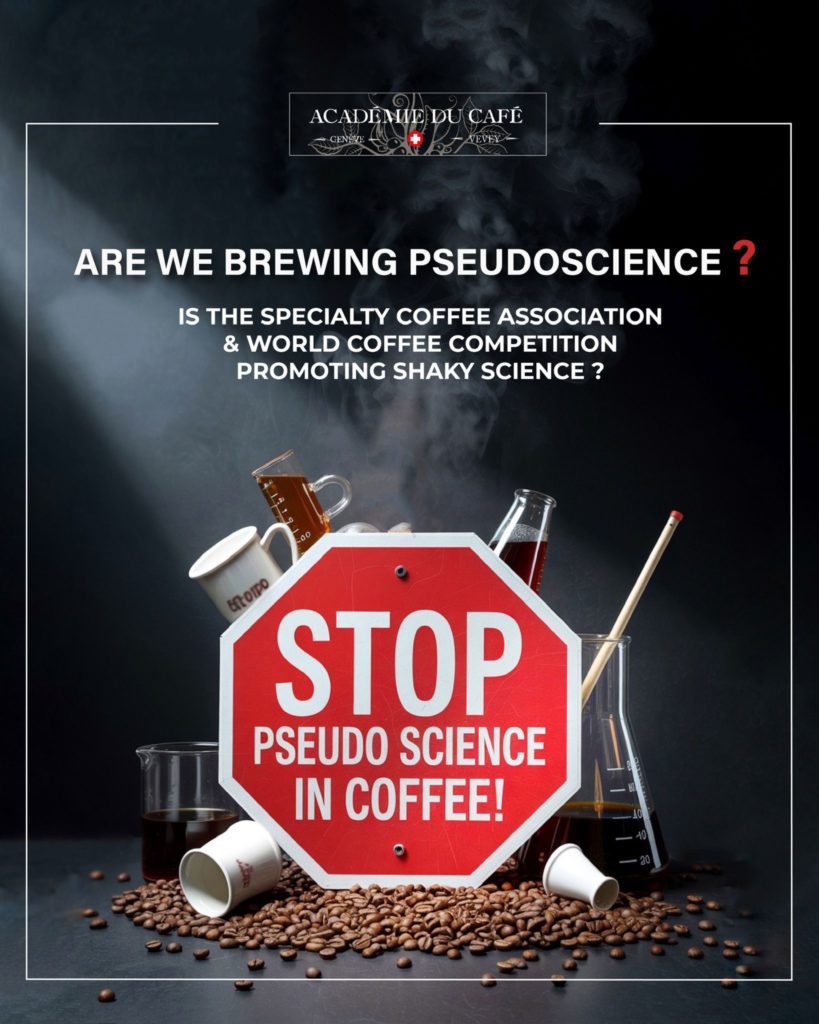
STOP PSEUDO SCIENCE IN COFFEE !
“Is the Specialty Coffee Association and World Coffee Competition promoting pseudoscience?”
In the world of specialty coffee, we place great value on rigour: crop provenance, processing, roasting profiles, sensory evaluation, chemical analyses. And yet I’m increasingly concerned that some practices currently endorsed (or at least tacitly accepted) under the SCA‐umbrella risk slipping into the domain of pseudo‑science. This happened at the last WBC in Milan where judges didn’t consider the real science and gave a very bad signal to the coffee community.
- Equipment as “magic bullet”
For example, I noted with interest (and a degree of alarm) the use of the Wave brewer at World Barista Championship 2025 in Milan. The underlying message seemed to be: this equipment = better control = better (or exceptional) flavour. But from a flavour‐science perspective we must ask:
- Has the brewer been subjected to peer‑reviewed studies showing reproducible sensory or chemical benefit over comparable brewers (for given bean/roast/parameters)?
- Are the purported benefits clearly attributable to the brewer, or are we instead witnessing marketing masquerading as science?
If the SCA endorses such equipment implicitly by its visibility in a WBC context, we run the risk of conflating innovation with hype. - Looking at scientific literature about this topic, no evidence can confirm the WBC’s champion claim. Sonication using ultrasound waves have very interesting impacts on extraction especially for cold brews, but electromagnetic waves at 500Hz… very hard to prove the cause-effect relationship.
- Mineral additions and “optimized” extraction
Another concern: the misuse (or over‑enthusiastic use) of mineral dosing during extraction—such as certain claims I’ve heard associated with some very well know brands in the market. The idea is: adjust the mineral content of water / extraction to achieve “ideal” flavour output. Certainly water strongly chemistry matters (we know that from ion strength, pH, buffering, etc.). But:
- Are the claims backed by rigorous blind sensory trials under controlled conditions?
- Is the mineral addition approach being portrayed as a universal “improvement” rather than a conditional tool (depending on bean, roast, grinder, filter, etc.)?
When the line between valid scientific optimisation and marketing hyperbole blurs, we risk eroding trust in truly scientific best practices.
- “Magic” Post-Harvest Processes for the creation of funky flavours
For dozens of years, coffee laboratories all around the world identified almost 1000 volatile compounds in roasted coffees. In the recent years, a lot of new molecules were discovered with strong key odorants such as orange blossom, grape, watermelon, strawberry and many others. Names like Thermal Shock, Maceration, Oxidation, etc let us think that temperature and fermentation can magically create key odorants never identified for decades.
My recent Gas Chromatographic Analysis showed coffees having clear flavouring agents (i.e. Methyl Anthranilate), flavouring solvent (i.e. Propylene Glycol and the related acetals) without any mention of the exact PHP treatment. The lack of transparency is altering the entire Specialty Coffee Community. - What this means for the community and training
As the owner of a coffee academy in Switzerland, I believe in equipping professionals only with science‑based skills. It matters that our training isn’t just replication of “what looks good on stage”, but rooted in reproducible, transparent and scientific evidences. When a leading organisation like the SCA appears to endorse (even indirectly) techniques lacking solid data, it complicates that mission.
STOP PSEUDO SCIENCE IN COFFEE !
I invite members of our community—trainers, Q‑graders, roasters, baristas—to join me in critical reflection:
- What criteria should the SCA use to evaluate new equipment/techniques before elevating them?
- How can we better ensure that mineral additions and water chemistry tools are taught with appropriate caveats and data transparency?
- How can training programmes help professionals distinguish between rigorous science and elegant marketing?