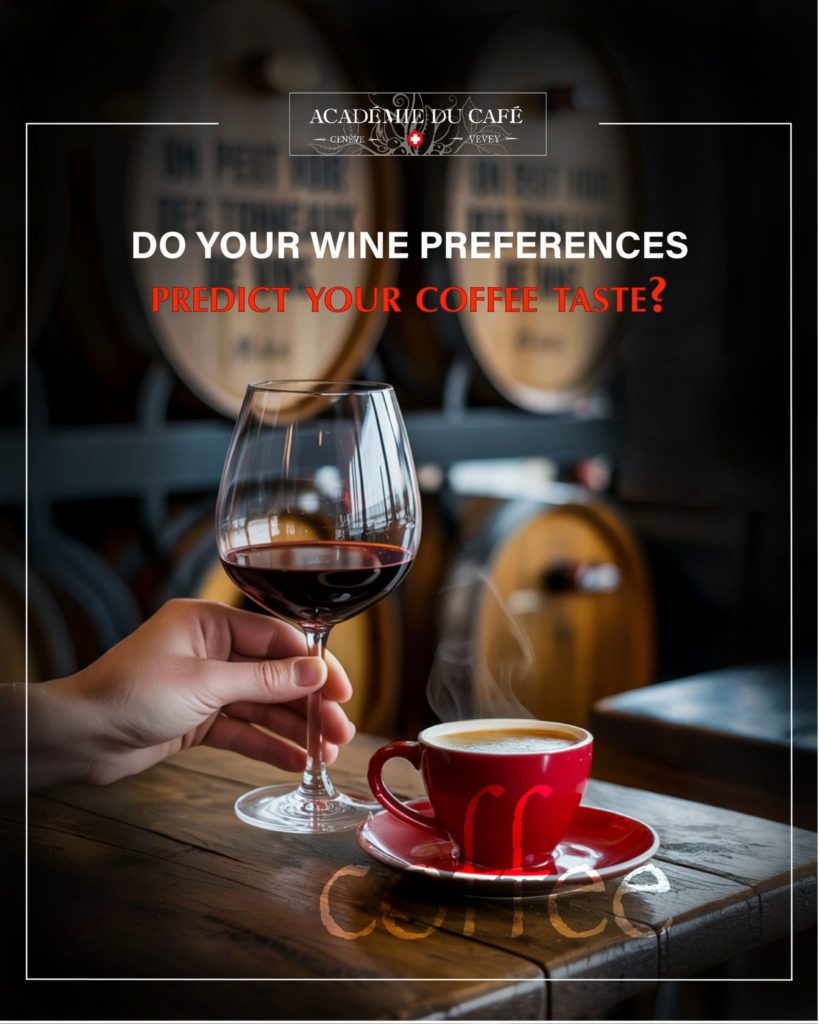
Do Your Wine Preferences Predict Your Coffee Taste?
As a coffee scientist and flavor analyst, I’ve often observed an intriguing correlation between wine preferences and coffee profiles. Could our taste in Bordeaux or Burgundy guide us toward espresso or filter brews?
Let’s explore the hypothesis:
Wine Lovers of Structure and Body
Fans of Bordeaux blends, Merlot, Cabernet Franc, or Grenache—typically fuller-bodied, rich in tannins, and lower in acidity—often gravitate towards coffees with similar structural cues:
- Espressos made from medium to dark roasts
- Blends with Robusta for crema and bitterness
- Less focus on aromatic complexity, more on body, intensity, and roast character
These consumers are less inclined toward the floral, tea-like notes of high-end Specialty Coffees. Think of it as preferring an intense ristretto over a delicate V60.
Wine Enthusiasts of Elegance and Acidity
On the other hand, if you enjoy Pinot Noir, Gamay, or cool-climate Syrah—lighter body, elevated acidity, subtle aromatics—you might find more joy in:
- 100% Arabica, high-altitude coffees
- Light to medium roast profiles
- Filter brews (V60, Chemex, Kalita) that highlight terroir, origin and fermentation
These are the Specialty Coffee enthusiasts who explore varietals, post-harvest processes, and terroir expression with the same curiosity as a sommelier.
What do we know ?
- Taste Genetics and Beverage Consumption
A large-scale Mendelian randomization study (2018) explored how genetically determined bitter taste perception influences consumption of coffee, tea, and alcohol. It found that individuals with heightened sensitivity to certain bitter compounds (like PROP or quinine) tend to consume less coffee, while greater caffeine bitterness perception was linked to more coffee intake. These associations, although statistically significant, were modest in magnitude. This connects taste perception to beverage choice, but does not address wine–coffee cross-preference directly. - Food & Beverage Pairing Methodology
A systematic review (2021) examined scientific approaches used in pairing food and beverages, including coffee, wine, tea, and beer. While it lays methodological groundwork (e.g., focusing on chemical similarities, aromatic congruence), the review highlighted the lack of experimental studies pairing wine and coffee. - Consumer Anecdotes and Sensory Personality
Informal observations from knowledgeable wine community members (e.g., forums like WineBerserkers) suggest correlations—for instance, people who enjoy black coffee often favor drier whites or bolder reds, while those who soften coffee with cream lean toward smoother reds. Though interesting, these are not scientifically validated. - Physiological Factors in Wine Perception
A recent study (2023) showed that salivary protein composition influences wine aroma perception and preference, revealing a biological basis for individual differences in sensory experience—but again, it doesn’t bridge the wine–coffee preference gap.
In Conclusion
There is no robust scientific literature directly supporting the hypothesis that consumers who favor strong, structured wines (like Bordeaux blends) will prefer robusta-based espresso blends, while those who enjoy lighter wines (e.g., Pinot Noir, Gamay) lean toward single-origin Arabica filter coffees.
That said, several studies highlight related sensory dimensions—such as bitterness tolerance and perceptual profiles—that could underpin such correlations.