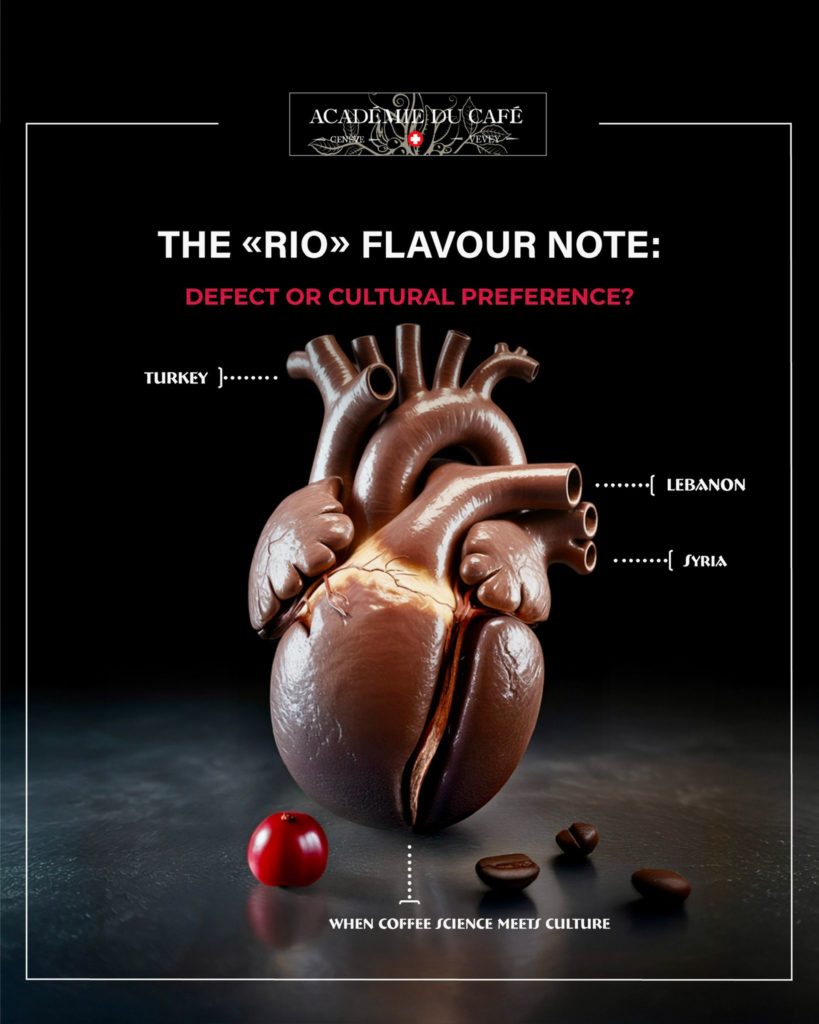
THE “RIO” FLAVOUR NOTE: Defect or Cultural Preference?
Coffee traditions in Turkey, Lebanon, and Greece highlight how cultural context shapes sensory appreciation. While globally dismissed as a defect, the so-called “Rio” flavour profile is deeply embedded in these regions’ coffee rituals, where long, slow boiling methods preserve and even emphasize its distinctive notes.
The “Rio” descriptor originated in Brazilian export classifications, historically linked to coffees from Rio de Janeiro, Espírito Santo, and Zona da Mata. These wet-harvested, warehouse-aged beans often developed an unusual flavour that became stigmatized in international trade. Sensory panels typically describe the Rio note as medicinal, phenolic, iodine-like, or musty — characteristics traditionally coded as faults. Yet in the Eastern Mediterranean, this same profile is valued as authentic and culturally emblematic.
Scientific studies by Spadone & Liardon (1990) and Cantergiani et al. (2001) identified 2,4,6-trichloroanisole (TCA) as the main compound responsible. Extremely odour-active, TCA has a detection threshold in coffee as low as 1–2 ng/L. It arises from microbial conversion of 2,4,6-trichlorophenol (TCP), particularly under humid post-harvest storage, involving fungi such as Aspergillus, Penicillium, and Rhizopus. Analytical techniques (GC-MS, GC-O sniffing) confirmed TCA and geosmin as dominant contributors to the musty/earthy character, with concentrations reaching 100 ppb in affected Brazilian coffees.
Roasting reduces TCA levels by only about 50%, meaning the compound’s sensory impact persists in the brewed beverage. Traditional decoction methods, common in Turkish and Lebanese coffee, further accentuate this profile.
The Rio note exemplifies the interplay of chemistry, history, and culture. It forces us to reconsider rigid boundaries between “defect” and “preference,” illustrating how sensory evaluation is never universal but always mediated by context and tradition.
#SpecialtyCoffee #coffeetasting #coffee #coffeelovers #coffeeculture #FutureOfCoffee #CoffeeEducation #CoffeeQuality #coffeeExperts
#learningcoffee
#coffeeknowledge #roastedcoffee #coffeetime