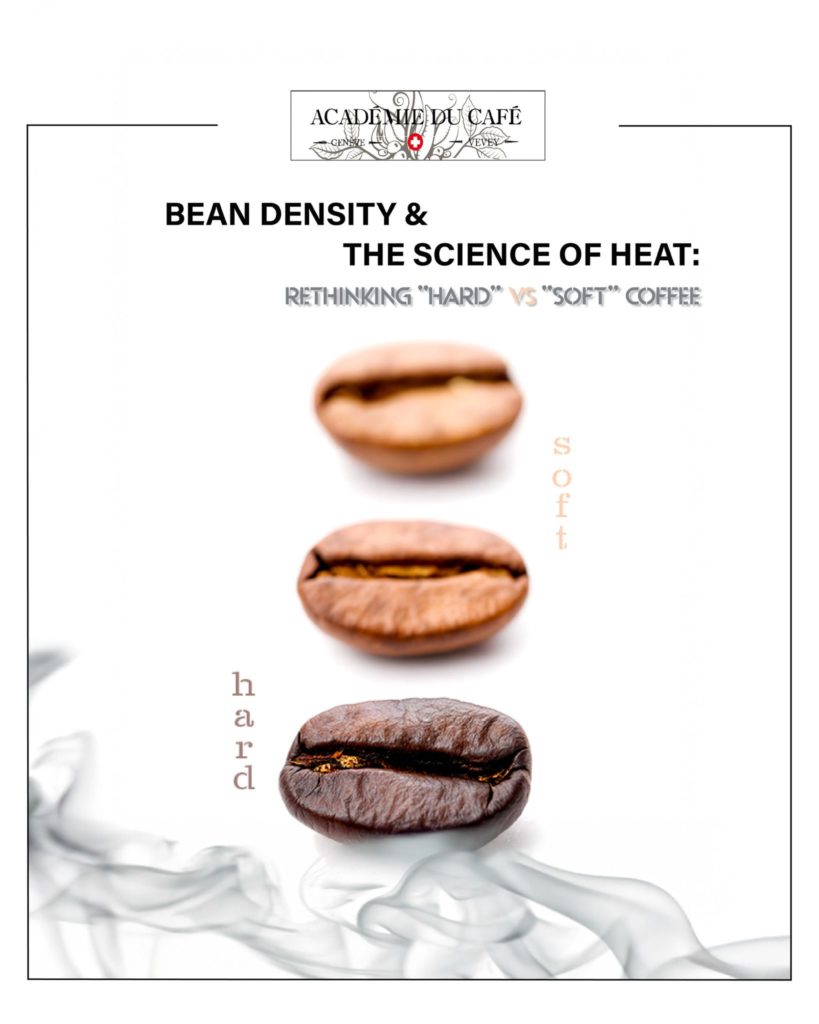
Roasting “hard” (high-density) vs “soft” (low-density) coffee: physical and chemical implications
Roasters often treat “hard” vs “soft” beans as a flavor category. Scientifically, it is primarily a materials and heat-transfer problem.
What “hard vs soft” really means
In practice, “hard” usually refers to higher apparent density (g/L), often associated with slower maturation (frequently higher elevations and cooler nights, but not exclusively), a more compact cellular structure, and lower initial porosity. Agronomic research shows altitude can drive measurable shifts in physical attribute.
Critical nuance: density is influenced not only by altitude, but also cultivar, shade management, nutrition, drying practices, and defects. Measure it—don’t assume.
Implications for roast strategy (physics → controls)
Drying phase (charge to yellowing): managing thermal gradients
Objective: avoid surface overheating in soft beans and internal lag in hard beans.
• High-density beans: require sufficient early energy to prevent sluggish heat uptake that later forces aggressive corrections, often leading to uneven development.
• Low-density beans: benefit from reduced conductive shock at charge and consistent bean movement via drum speed and batch discipline.
Maillard phase: diffusion vs reaction kinetics
Dense coffees tolerate and reward well-fed, uniform Maillard development, enabling sweetness and complexity without collapsing acidity.
Soft coffees can brown quickly at the surface while remaining internally uneven if early heat transfer was too aggressive.
Development phase (post-first crack): time vs energy
As porosity increases, bean behavior changes significantly. Modeling and experimental work show that moisture loss, expansion, and density evolve throughout the roast. Therefore, the rule “dense beans need longer development” is not universal.
Conclusion
Density is not quality. It is a thermophysical constraint that dictates how energy, airflow, and time must be managed to achieve uniform reactions and repeatable results.
#CoffeeScience
#RoastingScience
#HeatTransfer
#MaillardReaction
#GreenCoffeeScience
RoastDevelopmen