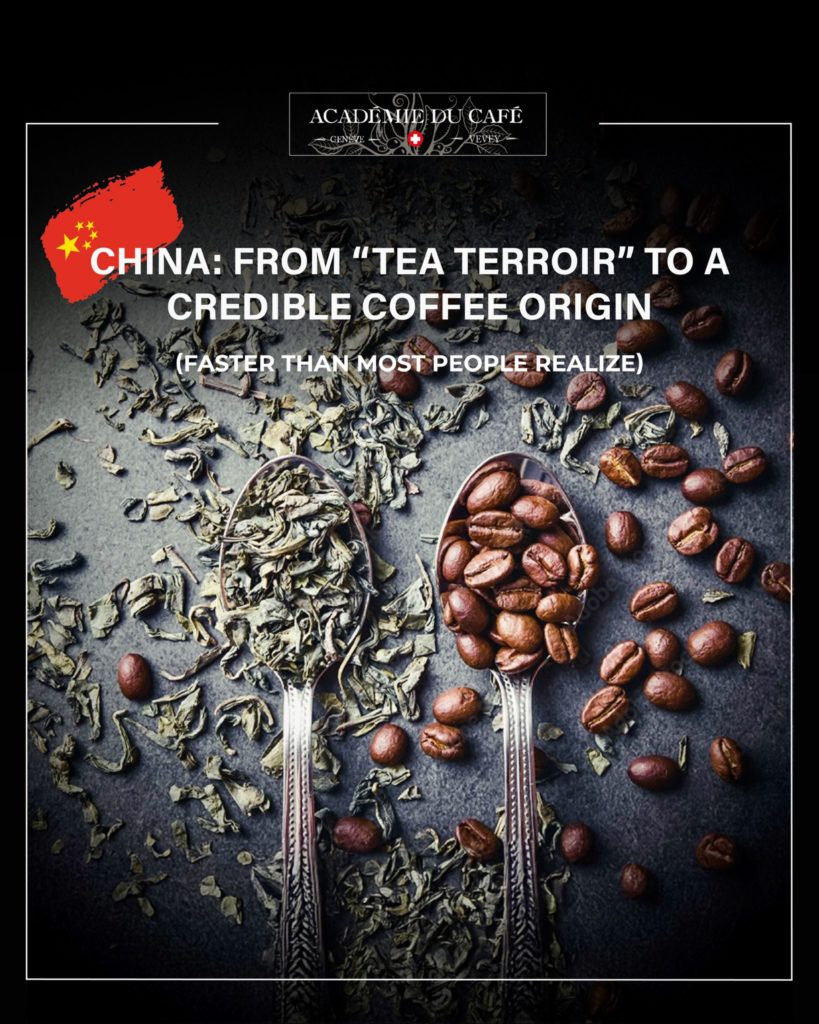
China: from “tea terroir” to a credible coffee origin (faster than most people realize)
For centuries, Chinese tea culture has trained consumers to care about origin, processing, and sensory nuance. Now that same “terroir mindset” is accelerating a new story: Chinese specialty coffee.
1) Where it grows (and why that matters)
The center of gravity is Yunnan, which accounts for >98% of China’s coffee area and production, with key zones often cited around **Pu’er, Baoshan, Dehong, and Lincang.
In 2024, Yunnan was reported at roughly 1.27 million mu of plantations and ~146,000 tonnes output.
2) Volumes vs. impact: small producer, big momentum
China’s production is still modest globally (around 1.9 million 60-kg bags in 2024/25), but domestic demand is exploding: consumption is forecast around 6.3 million bags in 2024/25.
And exports are becoming real: Yunnan exported ~32,500 tonnes in 2024 (+358% YoY reported).
3) Varieties: the “Catimor era” meets the flavor era
Yunnan’s dominant cultivar is often reported as Catimor 7963 (about ~90% of cultivation in one peer-reviewed paper).
That matters because the next quality leap isn’t only “new processing”—it’s genetics + picking discipline + process control.
4) Processing: the real specialty revolution
Specialty credibility depends less on fashionable labels and more on repeatability:
• Fermentation control (microbial succession, temperature, oxygen exposure)
• Drying control (water activity trajectory, mold/phenolic risks, cleaner cups)
A strong signal that infrastructure is moving upward: **Alliance for Coffee Excellence launched “Gems of Yunnan” as a CoE-style pilot pathway for top lots.
My take: this isn’t “tea being replaced by coffee.” It’s a tea country applying terroir thinking to coffee—and that’s why Yunnan is getting harder to ignore.
Question for roasters & buyers: what would convince you to list a Chinese coffee—cupping score, variety, processing transparency, or a consistent year-to-year profile?
#SpecialtyCoffee #ChineseCoffee #YunnanCoffee #CoffeeTerroir #EmergingOrigins