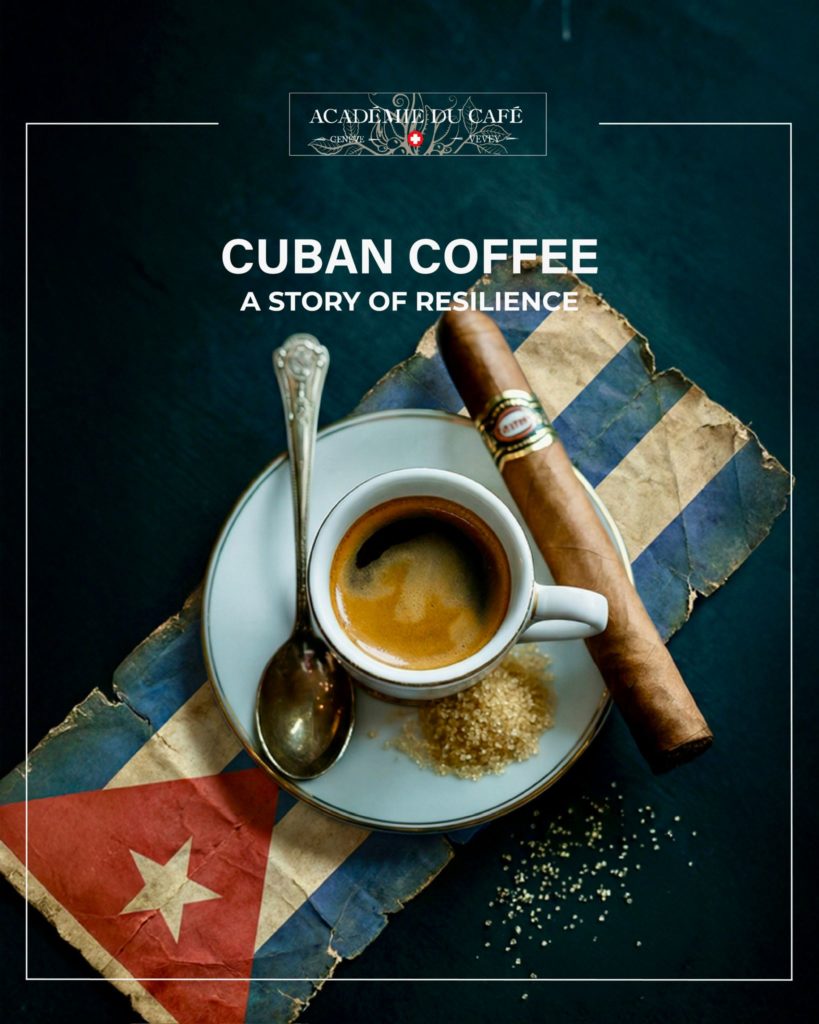
CUBAN COFFEE — A STORY OF RESILIENCE
Coffee arrived in Cuba in 1748, but it was the Haitian Revolution of 1791 that sparked a boom: French colonists brought advanced farming methods and settled the Sierra Maestra mountains. By 1961, Cuba hit a record 60,000 tonnes. The 1959 Revolution, the US embargo, and the Soviet collapse later decimated production — yet Cuba’s coffee culture never died.
REGIONS & TERROIR 92% of Cuba’s coffee grows in the Sierra Maestra (east), at ~1,200 m asl, with a humid subtropical climate, 20–25°C, and fertile reddish-brown humus-rich soils — no chemical fertilizers needed. Plants grow shade-grown under native forest canopies. Other zones: Escambray , Pinar del Río, Nipe and Sagua-Baracoa.
ARABICA VARIETIES Arabica covers 60% of production. Key varieties: Isla 6-14 & 6-11 (leaf rust-resistant), Bourbon, Caturra, and the prized Caracolillo peaberry. Quality grades range from Crystal Mountain and Extraturquino at the top, down to Turquino, Altura, and Serrano.
POST-HARVEST Harvest is manual and selective (Oct–Jan), picking only ripe cherries. Main processes: washed, natural, and honey. In the washed method, beans ferment 12–24 hours, are rinsed, then dried on raised beds for 3–4 weeks to 10–12% moisture.
FLAVOUR PROFILE: In terms of flavour, the Cuban coffees are located at low to medium high altitudes for arabica coffees. The sweetness is high to very high, heavy body and low acidity. Chocolate, Caramel and slightly fruity, this coffee is very close to Brazilian coffees, especially the natural ones.
ANNUAL OUTPUT In 2022, Cuba produced 9,000–11,000 tonnes total, with ~1,500 tonnes of Arabica exported to Japan, France, Germany, and Italy.
BIOCUBA CAFFÈ An Italian-Cuban joint venture between the Lavazza Foundation, Cuba’s Grupo Agroforestal (GAF), and AICEC Turin. It unites 170 small producers in Santiago de Cuba under organic certification via Slow Food’s Participatory Guarantee System. Every lot is traceable through the BioCubaCafeBlockchain®. Their blend La Reserva de ¡Tierra! Cuba is the symbol of a clean, fair, and fully transparent supply chain — coffee as it should be.