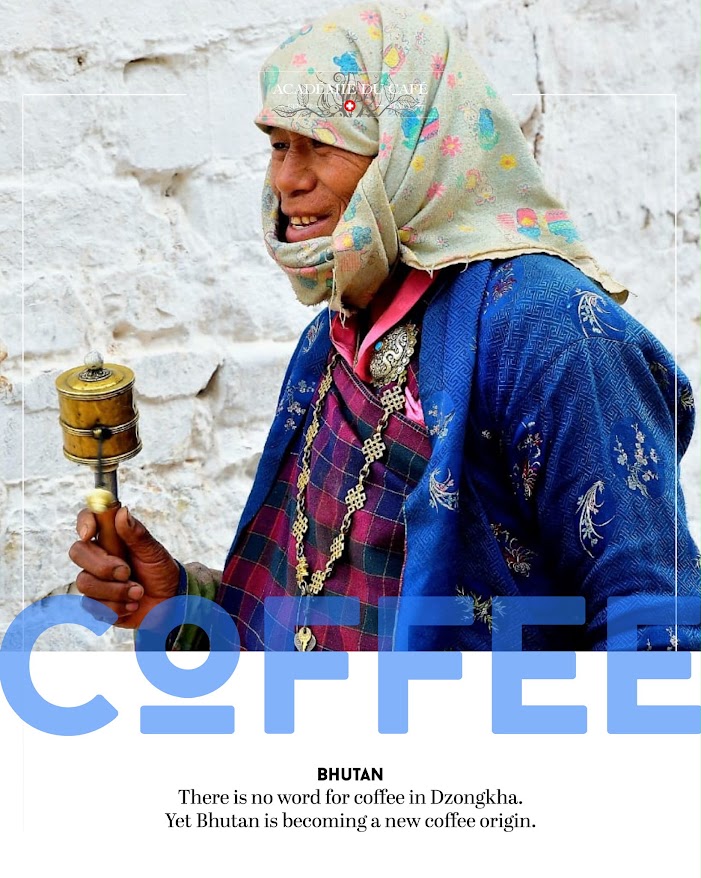
Bhutan: A New Coffee Origin in the Himalayas
Edited by Nat Coffee
There is no word for coffee in Dzongkha, Bhutan’s national language. Yet in October 2025, during my first visit to the Himalayan kingdom, I discovered a country that could soon become an emerging coffee origin.
Bhutan, a small constitutional monarchy nestled between India and China, first caught my attention when a Swiss photographer returned home with bags of “Bhutan Mountain Coffee.” Although the dark roast concealed much of the coffee’s original character, it sparked my curiosity about this little-known origin.
A month later, I joined a United Nations assignment to assess Bhutan’s coffee production and export potential. What I found was a young industry still in its pioneering phase.
In 2024, Bhutan inaugurated its first commercial coffee plantation in the Zhemgang district. Today, five nurseries supply Arabica and Robusta seedlings. The story began in 1987, when an agricultural officer introduced Arabica seeds from Colombia to Panbang. These plants gradually spread across the region and became linked to the Panbang Youth Cooperative, founded in 2019.
Supported by the United Nations Development Programme, the cooperative launched a seedling production project in 2024. The sector remains small but dynamic. The Panbang Cooperative focuses on production, while companies such as Himalaya Coffee, Bhutan Mountain Coffee, and CSI Market are developing cultivation, processing, roasting, and distribution.
Unlike neighboring origins such as Nagaland, Myanmar, or Sri Lanka, Bhutan has virtually no historical coffee tradition. Every plantation, nursery, and processing facility represents a pioneering step toward building a new agricultural sector.
Switzerland and Bhutan have already begun collaborating on coffee development, inspired by shared mountainous landscapes and similar values.
For those willing to wait, Bhutan offers something rare: distinctive single-origin coffees from Dagana, Zhemgang, and Mongar.
Thanks @nat__coffee